
Why TTO Tracking and Regular Audits Matter for Clinics Without an In-House Pharmacist
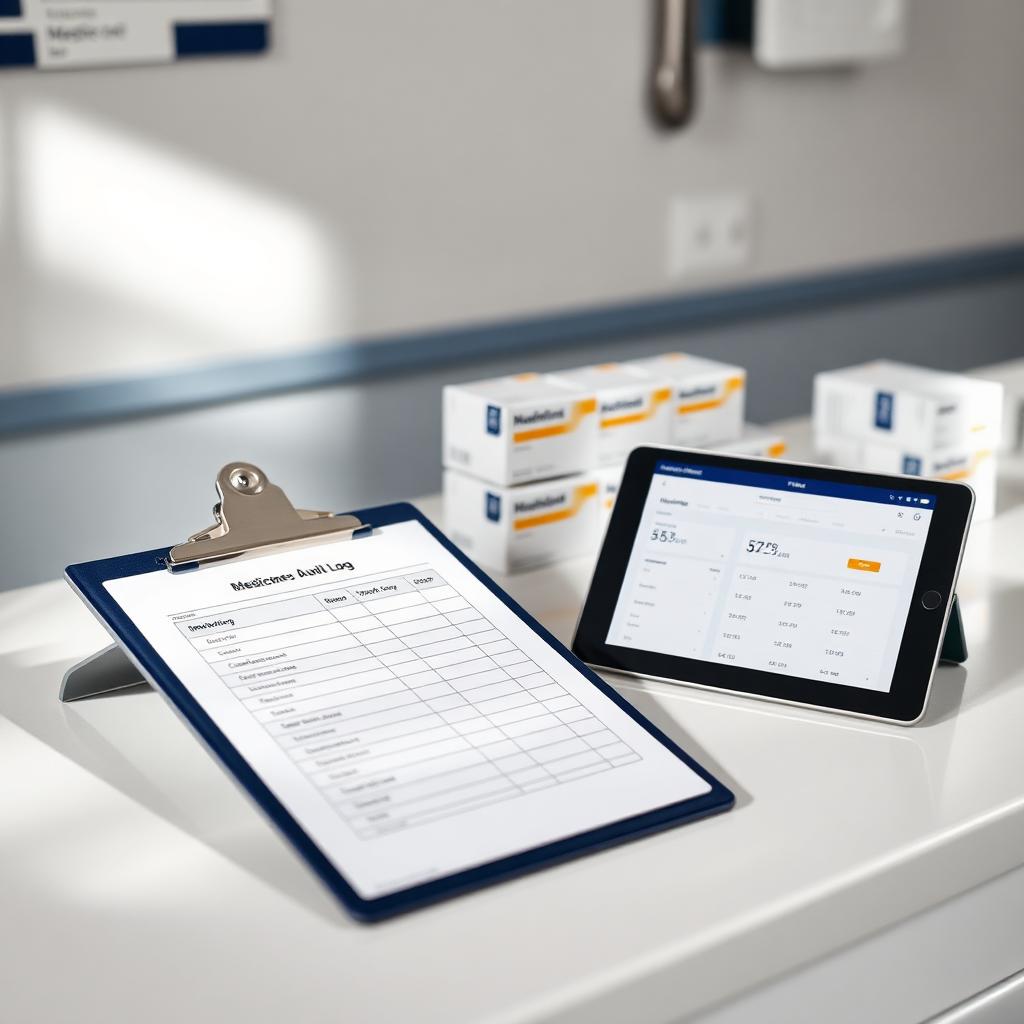
Most small and medium clinics in the UK — particularly in aesthetics, medispas, and independent treatment settings — don't have a pharmacist on site. Medicines are prescribed, stored, and dispensed by nurses, doctors, or other non-medical prescribers instead, often alongside a full clinical workload.
That's a completely legitimate way to run a clinic. But it also means the safety net a pharmacist normally provides — checking doses, flagging interactions, tracking batches, keeping dispensing records airtight — doesn't exist by default. It has to be built deliberately into how the clinic operates.
Two of the simplest, highest-value ways to build that safety net are a proper TTO (To Take Out) tracking system and a routine of regular audits. Neither requires a pharmacist. Both are well within reach of a small clinic team, provided the right systems are in place.
What a TTO tracker actually does
A TTO is any medication dispensed to a patient to take home after a procedure or consultation — a course of antibiotics after minor surgery, pain relief after a cosmetic procedure, or an emergency medicine like hyaluronidase after a dermal filler complication. Every TTO leaving the building is, in effect, an unsupervised handover: once the patient walks out, there's no clinician double-checking what they were given or how much.
A TTO tracker creates a clear, timestamped record of what left the clinic, in what quantity, from which batch, and who authorised and dispensed it. On its own that sounds like basic bookkeeping. In practice, it's the difference between being able to answer a regulator's or a patient's question in seconds, and having to reconstruct events from memory or paper notes days or weeks later.
Why this matters more without a pharmacist on site
In pharmacy-led settings, dispensing goes through a professional whose entire role is built around medicines governance — checking doses against guidelines, catching prescribing errors, and maintaining dispensing records as a matter of routine. Guidance from the Joint Council for Cosmetic Practitioners notes that in aesthetic settings, doctors and dentists holding their own medicine stock (rather than working through a pharmacist) take on the dispensing responsibilities a pharmacist would normally carry, and are expected to be personally accountable for the safe use and storage of that stock.
Without that pharmacist checkpoint, the accuracy and completeness of dispensing records rests on the clinic's own systems — usually whatever the treating clinician or reception staff manage to log in the moment, often while also running the rest of the day's appointments. A TTO tracker doesn't replace clinical judgement, but it does remove the administrative burden of remembering to log everything correctly, and it means the record exists reliably even on a busy day.
The CQC angle
For clinics registered with the Care Quality Commission, medicines handling sits squarely inside the "Safe" key question — one of the five areas CQC assesses on every inspection. CQC's own guidance for healthcare services asks providers to demonstrate that medicines are appropriately prescribed, administered, or supplied in line with current guidance, and that people receive their medicines as intended, with this properly recorded. CQC's national report on medicines in health and social care has previously found that medicines-related practice was consistently one of the weaker areas across the "Safe" question, across provider types.
An inspector reviewing a clinic without a pharmacist is likely to look even more closely at how dispensing is recorded and controlled, precisely because that usual professional checkpoint isn't there. A clinic that can produce a clean, searchable TTO log for any date range — instead of flicking through a paper diary or trying to recall specifics — presents a materially stronger picture of "well-led" medicines governance.
The MHRA recall angle
Batch and lot tracking is the other half of this picture, and it becomes urgent the moment a medicine recall happens. The MHRA issues medicine recalls at different severity classes, and for higher-severity recalls, the expectation is that affected patients are traced and contacted — guidance on defective medicinal products describes recall notices going out to recipients of the affected batch, with local procedures expected to identify what action needs to be taken in response. Where batch traceability isn't possible, the fallback is contacting every patient who may have received that medicine over a much wider window, which is both more disruptive for the clinic and more anxiety-inducing for patients who almost certainly didn't receive the affected batch.
A clinic that tracks batch/lot numbers against each TTO dispensed can instead search directly: which patient reference numbers received stock from batch X, on which dates. That turns a recall from a clinic-wide scramble into a five-minute, precise task — and it's one of the clearest ways non-pharmacist-led clinics can match the traceability standard that pharmacy-led dispensing takes for granted.
Why regular audits still matter, even with good software
A tracker only creates value if someone actually looks at what it's showing. Regular internal audits — say, monthly — catch the things that don't announce themselves: a batch that's been sitting in stock past its expiry without being flagged, a pattern of one medicine being dispensed unusually often, or a gap where a TTO was given but not logged correctly. These are exactly the kind of issues CQC inspectors are trained to probe for, and exactly the kind of issues that are cheap to fix when caught early and expensive — reputationally and clinically — when they surface during an inspection or, worse, after a patient safety incident.
For a clinic without a pharmacist, a simple audit routine is a reasonable substitute for the ongoing oversight a pharmacist would otherwise provide day to day. It doesn't need to be complicated: a monthly review of TTO records against stock levels, checking for expired or soon-to-expire batches, and confirming dispensing records are complete, goes a long way.
Practical takeaways
- Log every TTO with patient reference number (not name), medication, quantity, batch/lot number, date, and dispensing staff member
- Track batch/lot numbers at the point of goods-in, not just at the point of dispensing, so full traceability exists from delivery to patient
- Run a monthly audit of TTO and stock records, specifically checking for expired batches and dispensing gaps
- Keep records exportable/printable in a clean format, ready to hand to a CQC inspector without extra preparation
- Treat this as core clinical governance, not paperwork — in the absence of a pharmacist, this is what stands in for that layer of oversight
References
- Care Quality Commission — Medicines management (healthcare services): cqc.org.uk
- Care Quality Commission — Medicines in health and adult social care (2019 report): cqc.org.uk (PDF)
- MHRA / DMRC — A Guide to Defective Medicinal Products: gov.uk (PDF)
- Journal of Prescribing Practice — Responsible prescribing for cosmetic procedures (JCCP guidance summary): prescribingpractice.com
- NICE — Patient Group Directions guideline (MPG2): nice.org.uk
This article is provided for general information and does not constitute legal or regulatory advice. Clinics should check current CQC, MHRA, and professional body guidance directly, as requirements are periodically updated.